

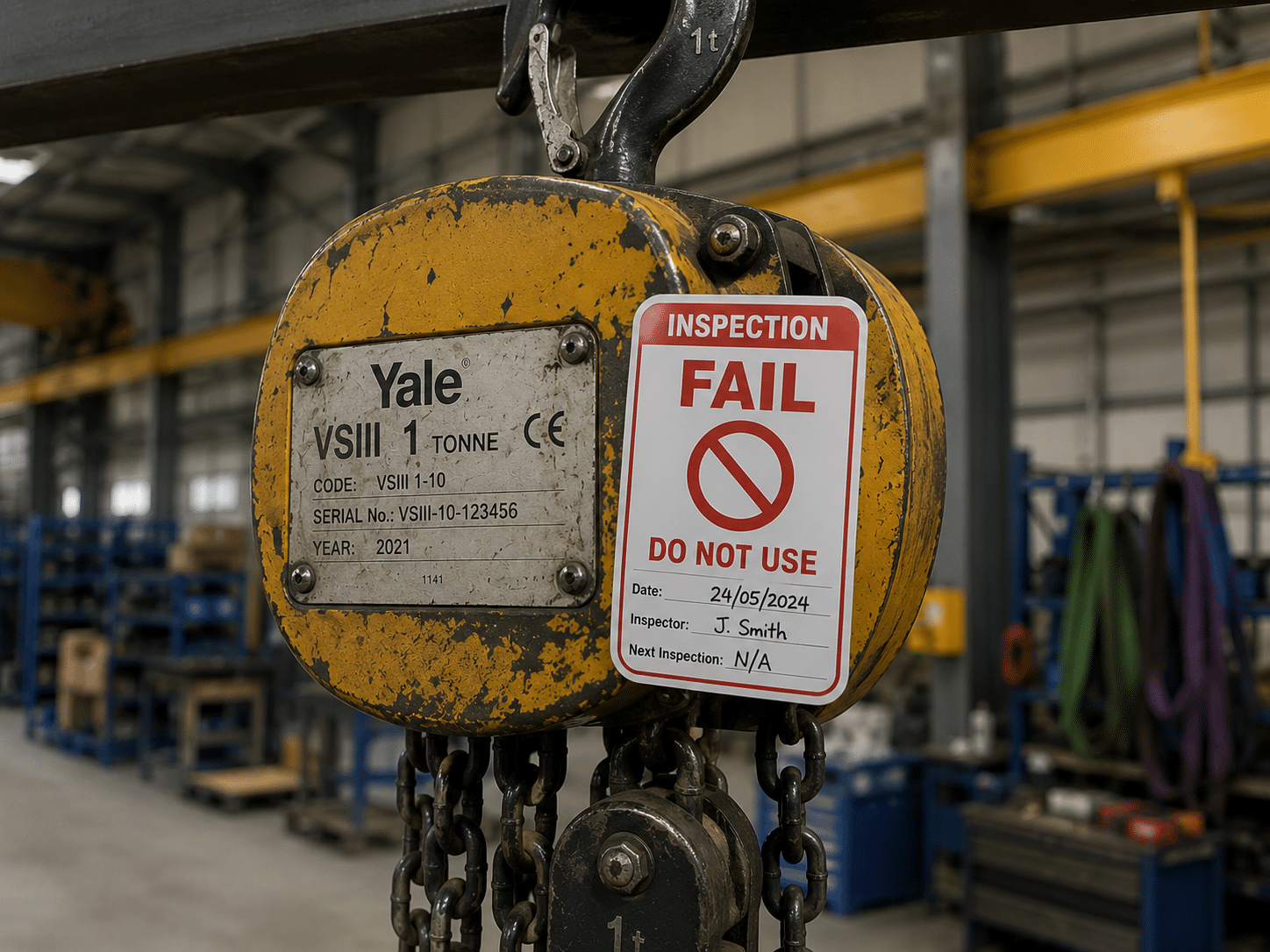
Discovering that your lifting equipment has failed a LOLER inspection can be concerning, but it’s important to remember that the inspection process is designed to prevent accidents before they happen. A failed inspection doesn’t necessarily mean the equipment is beyond repair, but it does mean you need to take immediate action to protect your workforce and remain legally compliant.
In this guide, we’ll explain what happens when equipment fails a LOLER inspection, what your responsibilities are and the steps you should take.
What Does a Failed LOLER Inspection Mean?
Under the Lifting Operations and Lifting Equipment Regulations 1998 (LOLER), lifting equipment (and lifting accessories) must undergo regular thorough examinations by a competent person.
During the inspection, a competent person must assess the condition of the equipment and identify any defects that could affect its safe operation.
If defects are found, they will generally fall into one of two categories:
- Serious defects that present (or could quickly become) a danger to people that require the equipment to be taken out of use immediately.
- Less serious defects that require repair within a specified timeframe but may not require the equipment to be taken out of service at this present time.
What To Do If Defects Are Identified
Step 1: Stop Using the Equipment Immediately (If Required)
If the inspector identifies a serious safety defect, the equipment should be removed from service immediately.
Continuing to use equipment that has been deemed unsafe could place employees at significant risk and may result in breaches of health and safety legislation and LOLER compliance.
The competent person is required to notify the duty holder immediately if a dangerous defect is found, followed by a written report confirming the findings.
Step 2: Quarantine the Equipment
Once equipment has failed, prevent anyone from using it by:
- Clearly labelling it as Out of Service.
- Removing it from the working area where practical.
- Isolating the controls or locking it off if it cannot be moved.
- Informing all relevant employees that it must not be used.
This helps eliminate the risk of accidental use before repairs have been completed.
Step 3: Review the Inspection Report
The LOLER report will explain:
- The defects that have been identified.
- Whether they present an immediate danger.
- Any repairs or remedial work required.
- Whether the equipment can continue to be used.
- The deadline for corrective action (where applicable).
- The date of the next thorough examination.
Understanding the report allows you to prioritise repairs and plan the next steps.
Step 4: Arrange Repairs Through a Competent Person
Repairs should only be carried out by suitably qualified engineers or the equipment manufacturer where appropriate.
Avoid temporary fixes or makeshift repairs, particularly on safety-critical lifting components.
Depending on the defect, replacement of parts may be required before the equipment can safely return to service.
Step 5: Have the Equipment Re-Examined
Repairing the equipment does not automatically make it compliant.
If the repairs affect the safety or integrity of the lifting equipment, another thorough examination may be required before it is put back into service.
Similarly, equipment should also undergo a thorough examination following exceptional circumstances such as damage, major modifications, long periods out of use or significant repairs.
Step 6: Keep the Required Records
LOLER requires businesses to retain records of thorough examinations and inspection reports.
These records should be readily available if requested by the Health and Safety Executive (HSE) or other enforcing authorities and should be protected from unauthorised alteration.
Maintaining accurate records also helps demonstrate that your organisation is managing lifting equipment responsibly.
What Happens if the Defect Is Serious?
Where the inspector believes a defect presents an existing or imminent danger to people, there are additional legal requirements.
The competent person must:
- Notify the duty holder immediately.
- Record the defect within the written report.
- Send a copy of the report to the relevant enforcing authority.
The HSE may then investigate to ensure appropriate action has been taken and that the equipment is no longer being used until it is safe.
Can Equipment Be Repaired Instead of Replaced?
In many cases, yes. A failed LOLER inspection does not automatically mean the equipment needs replacing. Many failures relate to worn components, damaged lifting accessories or defects that can be safely repaired.
However, if repairs are uneconomical, the equipment no longer meets safety requirements or has reached the end of its serviceable life, replacement may be the safest option.
A competent person can advise on whether repair or replacement is the appropriate course of action.
Preventing Future LOLER Failures
While not every defect can be prevented, businesses can significantly reduce the likelihood of failed inspections by:
- Carrying out regular pre-use checks.
- Following manufacturer maintenance schedules.
- Repairing minor defects before they worsen.
- Training operators to recognise signs of wear or damage.
- Keeping lifting equipment clean and properly stored.
- Scheduling routine maintenance between LOLER examinations where appropriate.
A failed LOLER inspection should never be ignored. Acting quickly not only helps you remain compliant with legislation but, more importantly, protects employees, contractors and anyone working around lifting equipment.
Regular inspections, preventative maintenance and good record keeping are the best ways to reduce the likelihood of future failures and keep your workplace operating safely.
Motion Kinetic helps businesses take control of their lifting equipment compliance by providing a centralised digital platform to manage inspections, maintenance and asset records in one place.
Ready to streamline your LOLER compliance? Contact our team today to discover how Motion Software can help you stay organised, reduce administrative burden and keep your lifting operations safe and compliant.